Y Plant Cells Have Cell Wall - Alyssa Is Observing Two Cells X And Y Each Cell Is From Either A Plant Or An Animal She Records Brainly Com / So animal cells can have various shapes, butplant cells only have the shapes of their cell walls.
byWilbert Phifer-
0
Y Plant Cells Have Cell Wall - Alyssa Is Observing Two Cells X And Y Each Cell Is From Either A Plant Or An Animal She Records Brainly Com / So animal cells can have various shapes, butplant cells only have the shapes of their cell walls.. The cell wall is a rigid and protective outer covering commonly found in both prokaryotic and eukaryotic organisms such as plants, fungi, algae, bacteria, and archaea, but is absent in all animal cells. In case the cell is treated with enzyme mixture of cellulase and pectinase. It also has structural proteins in smaller amounts and some one of the main reasons for having a wall in a plant cell is that it can withstand turgor pressure, and this is where cellulose plays a crucial role. Plant cells contain almost all of the organelles found in animal cells but have several new ones to help them survive. Breaks in the cell wall (pits) have cytoplasmic connections (plasmodesmata) through which exchange of materials occur.
All cells have cell membranes, and themembranes are flexible. While fungal necrotrophs extensively destroy the integrity of the cell wall through the combined action of. Many plant cells are green. The cell wall is mainly made up of cellulose fiber and it helps maintain the shape of the cell. How cellulose polymers are made;
Complete Microviscosity Maps Of Living Plant Cells And Tissues With A Toolbox Of Targeting Mechanoprobes Pnas from www.pnas.org It is a barrier that pathogens need to breach to colonize the plant tissue. Plant cells contain almost all of the organelles found in animal cells but have several new ones to help them survive. That's nice for plants, because it gives them the ability to grow up and out, where they can get lots of sunlight for making their food. Other than that, it helps to keep the plant turgid. The plant cell wall serves a variety of functions. Compared to drawings of cells from there are lots of different types of plant cell that must all work together to keep the plant alive. A cell wall is a fairly rigid layer surrounding, outside the cell membrane, the cells of plants and certain bacteria, archaea (archaebacteria), fungi, and algae. A cell wall is a structural layer surrounding some types of cells, just outside the cell membrane.
Cell walls are found in plants, fungi, bacteria, algae and in other archea.
Compared to drawings of cells from there are lots of different types of plant cell that must all work together to keep the plant alive. Cell wall provides turgidity to the cell and this results in the typically expanded form of the leaf laminas and erect stems. That's nice for plants, because it gives them the ability to grow up and out, where they can get lots of sunlight for making their food. All cells have cell membranes, and themembranes are flexible. Plant cells have chloroplasts (which make food for the plant through photosynthesis) and a cell wall. The cell wall is a dynamic structure that often determines the outcome of the interactions between plants and pathogens. Cell wall composition varies depending on the organism. How cellulose polymers are made; Yes, plant cells typically have a cell wall made up of cellulose, hemicellulose, pectin, lignin, etc. From the outermost layer of the cell wall, these layers are identified as the. Cellulose is laid down by enzymes to form the primary cell wall. Plant cells also usually have a distinct shape. Plant cells contain almost all of the organelles found in animal cells but have several new ones to help them survive.
Plant cells have cell wall because plants do not move from one place to another and hence they require rigidity which is cell walls are supporting structures that help the plant to have a fixed shape and protect it from injury. It helps to maintain the shape and osmolarity of thecells and acts as defense against pressure due to inflow of water. Plant cells also usually have a distinct shape. A cell wall is a structural layer surrounding some types of cells, just outside the cell membrane. Plant cell membranes are surrounded by a wall which is made of cellulose fibres.
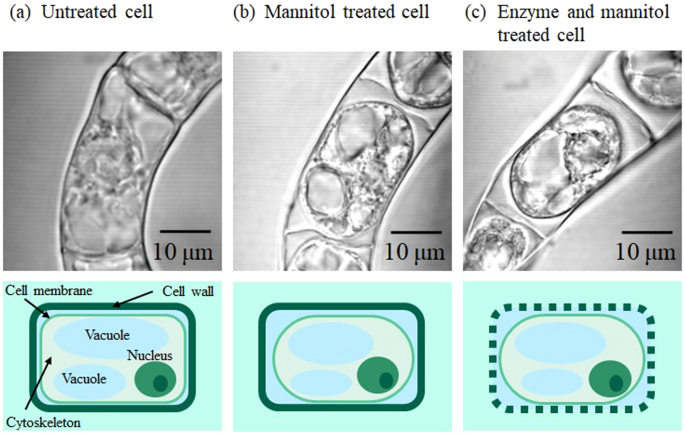
Enzyme Assisted Photoinjection Of Megadalton Molecules Into Intact Plant Cells Using Femtosecond Laser Amplifier Scientific Reports from media.springernature.com The cell wall of two adjacent cells are cemented together by middle lamella made up of calcium pectate. Cell walls are found in plants, fungi, bacteria, algae and in other archea. Plant cells are actively involved in water transportation, and thus plant cell wall ensures that the cell does not burst due to over expansion as water flows in (internal turgor pressure). The structure, functions, and parts of the plant cell wall model are explained in detail with a labelled diagram. Plant cells have a supporting cell wall, but animal cells do not. Protozoa and animals do not have cell walls and this is one of the major differences the cell wall of plants is a very remarkable structure as it gives the major difference between plant cells as well as other eukaryotic cells. Many plant cells are green. In plants, the cell wall is composed mainly of strong fibers of the carbohydrate polymer cellulose.
Yes, plant cells typically have a cell wall made up of cellulose, hemicellulose, pectin, lignin, etc.
In case the cell is treated with enzyme mixture of cellulase and pectinase. A plant cell wall consists primarily of carbohydrates, like pectins, cellulose and hemicellulose. The rigid exterior around the cells is necessary to allow the plants to microtubules guide the formation of the plant cell wall. Plant cells contain almost all of the organelles found in animal cells but have several new ones to help them survive. The cell wall is mainly made up of cellulose fiber and it helps maintain the shape of the cell. Unlike those of the prokaryotes, the components of eukaryotic (higher plants, algae, and fungi) the basic structural component of the cell walls of higher plants and most algae is cellulose. Yes, plant cells typically have a cell wall made up of cellulose, hemicellulose, pectin, lignin, etc. Because when it enters a high water potential solution, as. This extracellular matrix is characteristically absent from animal cells, although animal cells have extracellular matrix components on their surface. It helps to maintain the shape and osmolarity of thecells and acts as defense against pressure due to inflow of water. Made up of cellulose in plant and peptidoglycan in bacteria. Along with protecting the intracellular contents, the structure bestows rigidity to the plant, provides a porous medium for the circulation and distribution of water, minerals, and other nutrients, and houses specialized molecules that regulate growth and. The cell wall is a rigid and protective outer covering commonly found in both prokaryotic and eukaryotic organisms such as plants, fungi, algae, bacteria, and archaea, but is absent in all animal cells.
Bacterial cell walls are characterized by the presence of. The cell wall is mainly made up of cellulose fiber and it helps maintain the shape of the cell. Compared to drawings of cells from there are lots of different types of plant cell that must all work together to keep the plant alive. So animal cells can have various shapes, butplant cells only have the shapes of their cell walls. Cell wall composition varies depending on the organism.
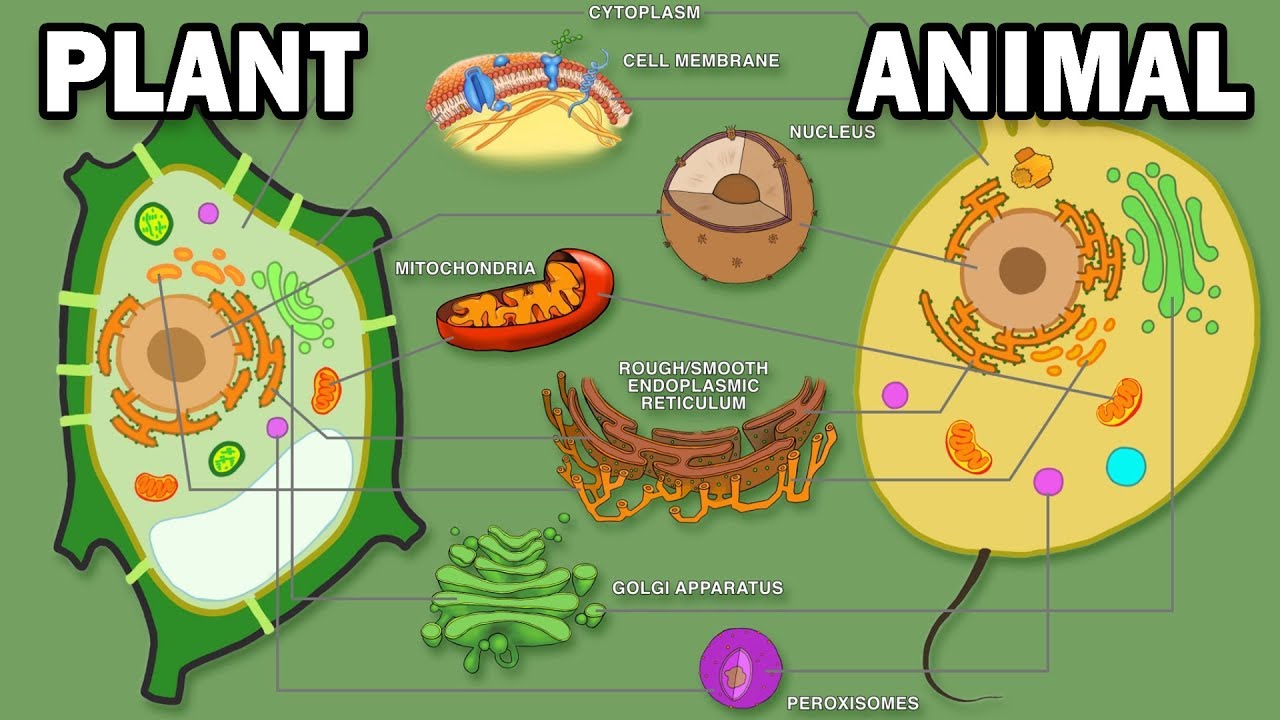
Plant Vs Animal Cells Youtube from i.ytimg.com It is considered as metabolic byproduct of the protoplast. Many plant cells are green. While fungal necrotrophs extensively destroy the integrity of the cell wall through the combined action of. Some plants also have a. Explain the synthesis of the primary cell wall. In case the cell is treated with enzyme mixture of cellulase and pectinase. The rigid exterior around the cells is necessary to allow the plants to microtubules guide the formation of the plant cell wall. Plant cell wall research at the ccrc is carried out by six independently funded groups.
The cell wall is a dynamic structure that often determines the outcome of the interactions between plants and pathogens.
It also has structural proteins in smaller amounts and some one of the main reasons for having a wall in a plant cell is that it can withstand turgor pressure, and this is where cellulose plays a crucial role. From the outermost layer of the cell wall the secondary cell wall is composed of organic compounds like cellulose, hemicelluloses, lignin, suberin, cutin, wax, etc. Plant cell and fungal cell wall. Unlike animals, however, plants are usually rooted to. Cell wall composition varies depending on the organism. There are three distinct layers in the cell wall. Plant cells have cell wall because plants do not move from one place to another and hence they require rigidity which is cell walls are supporting structures that help the plant to have a fixed shape and protect it from injury. Cellulose is a polymer of glucose residues that are connected via β(1→4) linkages. In plants, the cell wall is composed mainly of strong fibers of the carbohydrate polymer cellulose. How does the process begin? Learn about the functions and chemical components certain prokaryotes , algae , slime molds , water molds , and fungi also have cell walls. The cell wall distinguishes plant cells from animal cells and provides physical support and protection. It can be tough, flexible, and sometimes rigid.